STRENGTHENING FARMERS’ POSITION THROUGH NEW BUSINESS MODELS, LOCAL MARKETS AND COOPERATION
COREnet advisors contributed to the EU CAP Network Thematic Group on Farm Diversification, highlighting how Short Food Supply Chains, cooperation and new business models can strengthen farmers’ position in the value chain
From diversification to stronger farm businesses
In 2026, Patrick Pasgang, Jan-Willem van der Schans and Katalin Kujani, all advisors specialised in Short Food Supply Chains (SFSCs) and members of the COREnet project, contributed to the EU CAP Network Thematic Group on Farm Diversification.
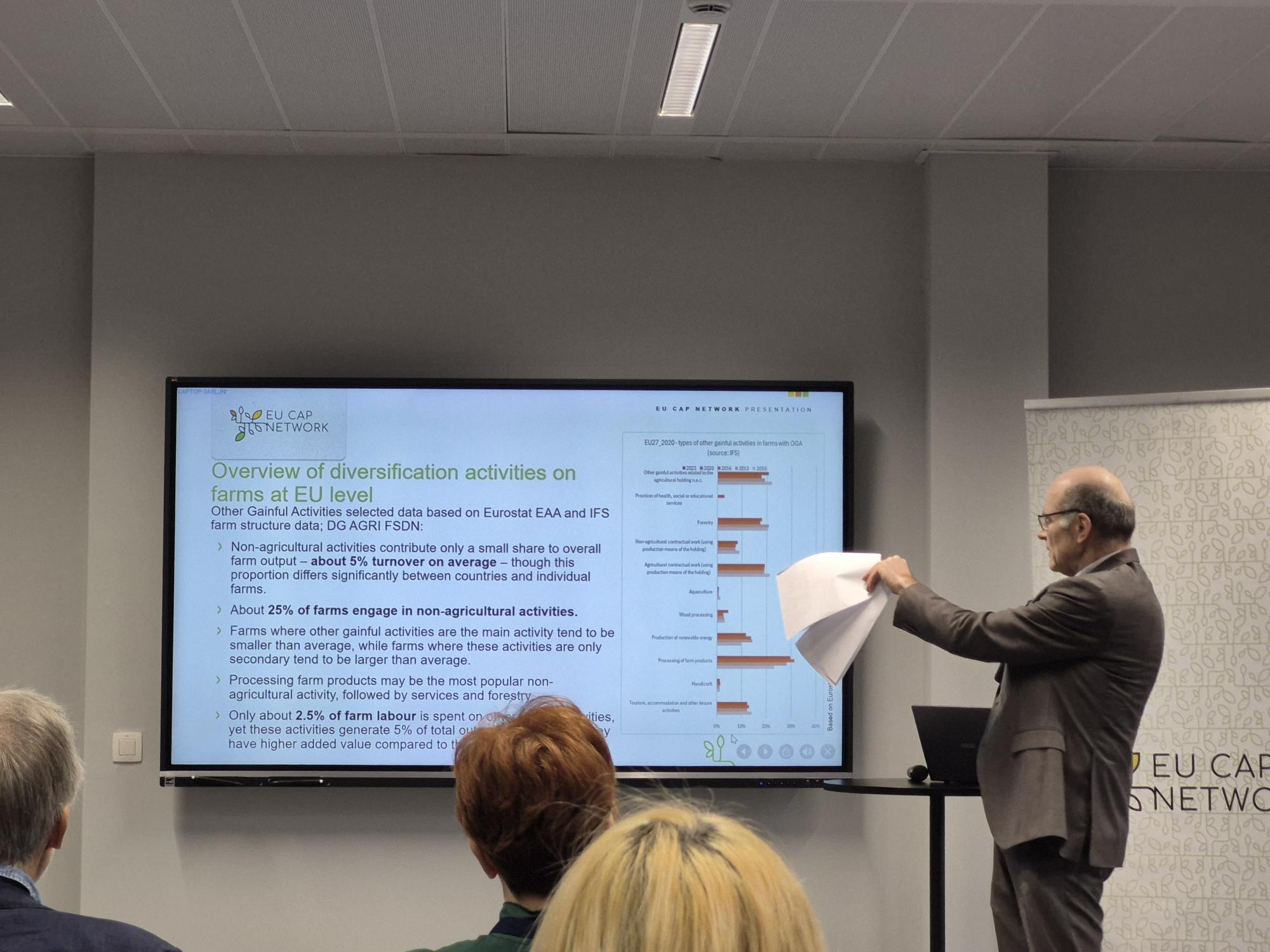
The Thematic Group brought together stakeholders from across Europe to explore how farm diversification can contribute to more resilient, economically sustainable and future-oriented farm businesses. Two meetings were organised: the first in Brussels on 4 February 2026 and the second in Rome on 6–7 May 2026. The discussions brought together practical experiences, policy perspectives and examples from different Member States.
A key point emerging from the EU discussion is that farm differentiation is increasingly becoming a full strategic choice rather than an additional activity alongside the core farm business.
The COREnet SAIA case illustrates this particularly well. SAIA applies a differentiated approach to its entire production, rather than selling the main production as a bulk commodity and adding speciality production for niche markets on the side. Much of the discussion around diversification has traditionally focused on this second model – for example, cases such as Ijshoeve, where surplus production was sold to a milk processing facility while differentiated activities were developed alongside it. SAIA therefore provides a useful example of how differentiation can become the basis of the overall farm strategy.
From diversification to stronger farm businesses
One of the main messages emerging from the Thematic Group is that diversification should not be regarded simply as adding an additional activity to a farm. It is increasingly a strategic business approach that can help farmers reduce economic vulnerability, spread risks and create additional sources of income.
For smaller and family farms in particular, diversification can strengthen resilience by combining agricultural production with activities such as processing, direct sales, retail, tourism, education, social farming, renewable energy or other locally embedded activities.
This leads to an important question:
How can diversification also improve the position of farmers within the value chain?
Moving from being a price-taker to becoming a value creator
A central opportunity of diversification is that farmers can take responsibility for more stages of the value chain.
Instead of selling an undifferentiated agricultural commodity to an intermediary, a farmer can increasingly process agricultural products, develop differentiated products and brands, sell directly to consumers, build relationships with restaurants and local retailers, organise farm shops or online sales, participate in local food hubs and cooperate with other farmers.
This allows farmers to retain a greater share of the value generated between production and consumption, while developing a closer understanding of market demand and consumer expectations.
The EU CAP Network explicitly recognises short supply chains and local food systems as part of the toolbox available to strengthen business competitiveness and diversification.
The strategic role of Short Food Supply Chains
This is where Short Food Supply Chains (SFSCs) can play a particularly important role.
Short supply chains should not be seen merely as a different distribution channel. They can become an instrument for farm diversification, entrepreneurship and value creation.
Direct and short-chain marketing can give farmers greater market power, more control over pricing and margins, better market intelligence, stronger product differentiation, greater resilience and stronger relationships with the local economy.
Local origin, quality, production methods, sustainability, animal welfare and the farmer’s story can all become part of the product’s value proposition.
From individual farmers to collaborative value chains
Another important lesson from the Thematic Group is that cooperation can be as important as diversification itself.
Many farmers cannot individually invest in processing facilities, logistics, marketing, digital platforms or new product development. Cooperation can therefore allow smaller farms to access markets and services that would otherwise be out of reach.
A professional short food supply chain may require a combination of farming, processing, logistics, marketing, digital tools, advisory support, cooperation and access to local markets.
The farmer does not necessarily need to own or manage every element. Cooperative or network-based models can allow farmers to collectively organise these functions while maintaining a stronger position in the market.
Concrete examples from the EU CAP Network
The new Farm Diversification – Projects Brochure provides eight practical examples demonstrating how diversification can strengthen farm businesses.
One particularly relevant example is Ahisilla Taluaed in Estonia. A family vegetable farm diversified into free-range egg production, using vegetable residues as feed and developing its own farm brand and direct marketing strategy. The eggs are sold to Michelin-star restaurants, local shops and through a self-service farm shop. The diversification resulted in more stable income and was subsequently complemented by farm tours and educational activities.
Another relevant example is Csalános BioFarm in Hungary, a small family farm that diversified its livestock and organic cheese production, combining investments in production capacity with improved marketing and plans for direct local sales.
The brochure also includes Biobased Farmers in Flanders. Although this is not an SFSC food example, it shows how farmers can become suppliers of new products and services by connecting with other sectors. The project brought farmers together with architects, researchers and the construction sector to develop new uses for agricultural residues and alternative crops.
What does this mean for the COREnet project?
The experience of the Thematic Group reinforces the relevance of the COREnet approach to advisory support for Short Food Supply Chains.
If farmers are expected to strengthen their position in the value chain, they need more than technical production advice. They need access to business-oriented, market-oriented and chain-oriented advice.
Advisors can help farmers identify opportunities for diversification, analyse where value is created and captured, assess whether shorter supply chains could improve their business model, select appropriate sales channels, calculate costs, develop cooperation, understand market trends and build professional marketing and branding strategies.
This makes the advisor an important connector between the farmer, the market and the wider innovation ecosystem.
Short Food Supply Chains as a pathway towards greater farmer autonomy
The discussions of the Thematic Group suggest that the future of farm diversification should not be about encouraging every farmer to “do more”.
Rather, it should be about helping farmers to make strategic choices about where and how they can create and retain value.
For some farms, this may mean processing. For others, direct sales or a farm shop. For others, cooperation with restaurants, schools or local retailers, or activities such as tourism, social farming, renewable energy or the bioeconomy.
SFSCs can connect many of these strategies.
They can transform a farmer from being primarily a supplier of raw agricultural products into an entrepreneur who creates, markets and communicates value.
A final message for policy and advisory systems
The Thematic Group ultimately developed nine proposals for improving the policy environment for farm diversification, including clearer definitions, dedicated support mechanisms, financial incentives for clusters, stronger skills and professionalism, improved access to finance and dedicated advisory, networking, knowledge exchange and innovation support.
For SFSCs, this suggests an important policy direction:
Farm diversification, short supply chains and advisory support should increasingly be viewed as interconnected elements of a strategy for strengthening farm resilience and farmers’ position in the food system.
Rather than supporting individual investments in isolation, future support systems could focus more strongly on integrated business models, cooperation, market access, value creation and the capabilities needed to manage these new business models.
The role of COREnet and its advisory network is therefore highly relevant: helping farmers navigate this increasingly complex environment and turning diversification opportunities into viable, market-oriented and resilient farm businesses.