GENDER PERSPECTIVES ON SHORT FOOD SUPPLY CHAINS: A CASE FROM THE “IRELAND – KENYA DAIRY PROJECT”
Isaura Mauelele recently spent her placement in Teagasc (Galway, Ireland), gaining insights from the Ireland-Kenya Dairy Project, taking a partial focus on COREnet from a gendered perspective.
Written by Isaura Mauelele – Social Development and Gender Specialist
Short Food Supply Chains (SFSCs) are becoming a model to follow to improve the food chain flow, connecting producers and consumers. According to COREnet (2021), SFSC is seen as a supply chain that involves a limited number of intermediaries connecting farmers and consumers, with commitment to cooperation, local economic development, while maintaining close geographical and social relations.
There are gender dynamics in food supply chains, where women play an important role in their functioning, especially in production as farmers and organic farm food processors, due to the feminization of specific roles. Gender-responsive approaches in SFSCs are important to increase the participation of women as farmers, farm managers, farm food processors, informal consultants, etc. Anderson et al. (2021) states that growing body of evidence postulates that empowering women in agriculture may lead to economic benefits for women themselves and for their households and communities, which will be shown in some examples of agricultural projects, in the contexts of Ireland and Kenya.
In this perspective, gender approaches will be presented for two agricultural projects that use the Short Food Supply Chain model, where there is a connection between farmers, consumers and markets, with the role of advisors being important. The ‘Dairy Kenya Ireland’ project is one such large project in Kenya, with a SFSC for local dairy production, marketing and sales, involving smallholder farmers, funded by the Embassy of Ireland in partnership with Teagasc – Agriculture and Food Development Authority, KALRO, Greenfield International, and overseen by Self Help Africa.
According to Hennessy (2024) the project aim is developing and demonstrating new improved forage-based dairy farming systems that are resilient to climate change. There is a SFSC for dairy production in the project, with marketing and sales, where the role of advisors includes providing knowledge transfer to small farmers in terms of environmentally smart technology for irrigation systems and climate resilience, and capacity building for women farmers’ participation in decision-making.
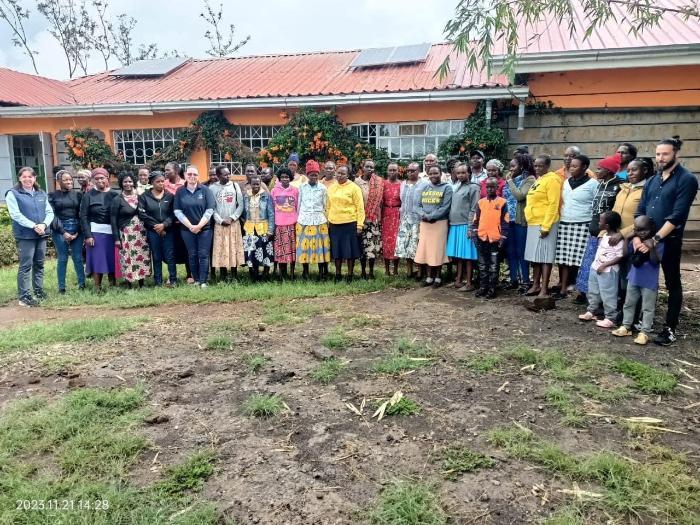
Looking at the gender roles within the ‘Dairy Kenya Ireland’, in an interview (May 2025) the project team members explained that most men play the role of business owners, owning the land and livestock (cows). Women harvest and irrigate crops using environmentally friendly systems and smart technologies provided by the project. This irrigation technology makes work easier for women farmers, who previously had to travel long distances to fetch water for irrigation.
While there are some female entrepreneurs who are farmers and landowners – usually single mothers and widows, married women manage the household budget on small farms but have little control over the farm’s assets and cash. Cultural aspects, especially in rural communities, limit women from owning assets, as the World Bank (2022) states that women face constraints in accessing and using farm inputs, such as restrictive gender norms, limited resources to purchase inputs, and unequal distribution of information including resources, between men and women within and between households.
To address this gender imbalance, the project offers a capacity building program to increase women’s participation in decision-making. As Anderson at al. (2021) emphasizes, one of the pathways to have economic benefits from empowering women in agriculture, is to increase their access to and control over agricultural inputs, which will increase agricultural productivity by reducing gender productivity gaps.
Hennessy (2024) also states that ‘Development Pamoja’ – the Kenyan local organization implementing the dairy project, has a ‘Demonstration Farm’ which acts as a meeting space for farmers to have a “Savings and Loan” program, as well as a Cooperative where farmers come together to share their experiences and face challenges. Women farmers also participate in the ‘Savings and Loan’ program, organized in groups of 20 women where they obtain loans, including machinery to promote farm activities. In return, they pay a certain amount to the program after selling the product.
The role of Advisors in this project is fundamental to provide knowledge through the ‘Demonstration Farm’, with the implementation of climate-resilient agricultural practices, since the local community face challenges of drought. In this process, there is technology transfer to farmers including women, since harvesting and irrigation are feminized activities, along with the support of an extension team that provides training to 200 farmers on their small farms, where women represent a significant number.
Short Food Supply Chains have different operators, from producers, farmers, workers, consumers to consultants. Macken-Walsh (2025) presents that the role of advisors is to connect the farmer to the market, advising on aspects of production, regulations, routes to market and marketing, etc. In ‘Dairy Kenya Ireland’ project, both men and women participate in the marketing of the product, and act as informal advisors, marketing it in various markets.
Through the local cooperative, women farmers and men business owners participate in decision-making and find ways to connect with the market, while being involved in the ‘Savings and Loan’ program. The capacity building program provided by the project, is a way to increase the participation of women farmers in the ‘Savings and Loan’ program, showing that empowering women throughout the SFSC is important to increase their participation in the food value chain, adding value to improving production, as women play an important role as farmers and informal advisors.
A gender-responsive approach to zero-waste dairy by promoting a short cheese supply chain
With an approach of developing an effective Short Food Supply Chain advising process with peer-to-peer learning, connecting farmers to consumers and markets, COREnet is another project implemented in the European context, as a partnership between many regional organizations. According to COREnet (2021) the project aim is to identify knowledge including regulatory and policy recommendations, where the role of advisors is important to enhance the food value chain. The project is a partnership between several institutions and has the initiative of ‘Golden Cases’ to identify good practices in SFSC with formal or informal advice.
When it comes to gender approaches, Marika and Palomba (2015) state that women participate in multifunctional food supply chain activities, from farmers to producers. In rural areas women act as farmers, organic farm products producers (e.g. cheese value chain), farmers managers, agricultural entrepreneurs, and informal advisors connecting farmers to consumers and markets, especially in agrotourism.
COREnet has examples of the work women do in SFSC, particularly in cheese production, on Irish farms. Kylemore Farmhouse Cheese is an example of an Irish farmhouse cheese produced on local farms, with women actively involved in the cheese value chain as cheesemakers and farm manager. Kylemore Farmhouse Cheese (2025) presents that this food value chain is committed to empowering women in agriculture, while creating jobs in rural Ireland, to enhance health and well-being in the communities.
Women in this cheese production add value to the SFSC while concentrating on sustainability, by using alternative forms of enterprise in their farm, producing sustainable milk and cheese with a low carbon footprint.
As the Dairy Kenya Ireland project focuses on milk production, the ‘Golden Case’ of women’s participation in the cheese value chain can be considered as a model to follow, especially if there is surplus milk after its sale in the market. In this perspective, women who act as active economic agents in agriculture, such as farmers producing forage-based dairy farming in the ‘Dairy Kenya Ireland’, can be involved in reusing surplus milk to produce cheese as an organic agricultural product, which can contribute to the supply of this product to the market. This effort can be carried out within the existing local cooperative, as a unit in the production chain.
Implementing an organic and chemical-reduced cheese supply chain in dairy production with the participation of women as farmers and cheese makers, by reusing the surplus of milk, will increase women’s participation along the Short Food Value Chain, and add value by producing healthy farm based organic food. This will also increase households and local communities’ income, and as Urbact (2022) shows, reusing food by processing it, will avoid food waste especially after periods of global crisis such as COVID-19.
In terms of advisory services for the cheese supply chain, based on the experiences of the COREnet project, particularly its ‘Golden Cases’, an approach could be considered to reinforce the role of advisors, embodied in the transfer of knowledge to local producers in cheese production, offering advice on the value chain of organic cheese production in relation to environmental and health safety standards, packaging, marketing routes and access to cheaper production equipment. As both men and women play the dual role of producers and informal advisors, this could be reinforced with formal advisory services, which would increase their ability to reach more markets, connecting local farmers with consumers.
This approach will increase experience sharing and synergies between farmers, workers, farm business owners and advisors at the ‘Demonstration Farm’ and the local cooperative of the ‘Dairy Kenya Ireland’ project. By integrating the cheese production value chain, the ‘Savings and Loan’ programme can be strengthened, enabling both female farmers and dairy business owners to obtain more loans, increase their production and acquire the ‘tools’ needed to develop a cheese value chain.
Advisory Services: Meeting the Needs of Women in SFSC
Several projects have confirmed that small farmers suffer from a knowledge, skills and competence gaps in all SFSC phases. Advice in SFSC is important to enhance the work of farmers including to women farmers, farm food makers, farms managers, food processors, and can be achieved with the collaboration of an advisor or advisory services.
Marika and Palomba (2015) argue that female agriculture entrepreneurship proves to be beneficial, especially in promoting the multifunctional nature of the agricultural production, with food processing and the provision of certain services such as educational farms.
Farmers and food processors, including women in this sector, may have specific needs in terms of consultancy services, where access to different markets – local or regional, access to machinery and equipment, knowledge of market regulations and health/environmental standards in food production and processing are some important aspects to consider when providing consultancy.
There are more examples of women in rural areas acting as farmers and advisors, producing organic agricultural products and contributing to environmental sustainability. Kate Carmody is an example of an organic farmer, cheesemaker and environmentalist on Irish farms. Carmody (2025) shows that their experiences involve health and safety, artisan food systems and quality systems.
Connecting female-owned food businesses with the market through online marketing sources tends to be a form of shared advisory services offered by online marketing source experts. Anderson et al. (2021) find that women’s empowerment in agriculture is associated with higher female use of inputs and technology, suggesting that increasing women’s access to and use of productive resources leads to economic benefits such as increased agricultural productivity.
Access to finance for investment in agricultural and food businesses is a challenge for small farmers in SFSCs, as COREnet (2021) presents that the ability to obtain loans following banking regulations can be difficult. In general, in agricultural programmes/ businesses, female small farmers tend to face more difficulties in obtaining financial resources. The World Bank (2017) presents that women farmers often face significant barriers in accessing finances for their agricultural activities compared to their male counterparts, and this disparity in access to finance, along with other challenges like limited access to land, inputs, and markets, hinders their productivity and economic empowerment.
In this sense, the Food and Agriculture Organization of the United Nations (2019) reinforces that having access to financial services allows rural women to procure the inputs, labour and equipment they need for their agricultural or rural off-farm activities. Anderson et al. (2021) add that there are positive effects of empowering women by increasing their control over productive resources, through directly providing inputs for them or lowering the costs to obtaining such resources.
Therefore, it is important to provide advisory services to women in the Short Food Supply Chain on how to access less demanding types of financing, with information on food processing techniques, such as organic methods, which require less use of technology and low financial investment.
Integrating gender dimensions into policies related to advice in SFSCs
Advice is provided in an ad hoc way in most EU member states, and relevant knowledge of Short Food Supply Chains, including skills and competencies relating to advisory services are largely absent, especially in relation to their role as enablers of more effective collaboration.
In some SFSCs, women also act as informal advisors, playing a multiply role of smallholder farmers, organic food processors and connecting farms to consumers and markets. The provision of advisory services to women in SFSCs can be enhanced by influencing policymakers to consider a gender-responsive approach to food and agricultural policies through the allocation of human and financial resources.
This intervention can be adopted to facilitate knowledge transfer to both men and women in SFSCs, ensuring that actions are promoted that can contribute to increasing the number of women with resources to act as farmers, food processors, managers and advisors. In this regard, the COREnet ‘Golden Cases’ has examples of initiatives involving women in agricultural production and food processing, with informal and formal advisory services, which can be highlighted through the promotion of workshops and roadshows connecting a diversity of stakeholders such as women advisors, farmers, food processors (e.g. cheese makers), farm managers, and policymakers.
This approach will create a space for a sharing of ideas, knowledge and experiences, building new strategies that can be translated into policies, to facilitate advisory services to women in agricultural and food businesses, while also driving initiatives to financially support female initiatives, as a way to encourage more participation of women in Short Food Supply Chains as farmers, food processors, farmer managers, including advisors.
Isaura Mauelele is a Social Development and Gender Specialist with professional experience of 12 years, in Mozambique. She has a degree in Law and a Master’s in Gender, Globalization and Rights (2025). Works in the areas of gender equality, public policies, human rights, focusing on gender mainstreaming in national agricultural projects, climate resilience, food and nutrition security, land use, women, youth and local communities’ economic inclusion, in Mozambique. Has attended short-term courses on gender, sustainable agriculture, climate change, and communication.
Photo credits: Isaura Mauelele